Corporate America has remained mostly silent in the face of U.S. President Donald Trump’s cruel and largely illegal immigration crackdowns, but a growing segment of communities is pushing back. With protests emerging against federal deportation flights, the NCAA March Madness tournament creates a new opportunity to raise awareness and advocate for change.
March Madness puts a spotlight on charter airlines
The National Collegiate Athletic Association’s March Madness tournament is an annual rite of spring for millions of college basketball fans and sports bettors. This year’s tournament includes 136 teams competing in an elimination series televised from March 15 to April 6.
“The first two days of the NCAA men’s basketball tournament have become like national holidays in American culture,” Madison Williams of Sports Illustrated observed this week.
This year’s tournament already broke viewership records while registering 36 million brackets for fans to forecast the final outcome. “March Madness has become more than a tournament. It is a shared experience that pulls in casual fans, office pools and social conversations, making participation feel almost expected,” the editorial board of TribLive, a Pennsylvania sports publication, reported yesterday.
Given the public profile of March Madness, the potential for immigration enforcement to disrupt the games has become a matter of public concern.
Over the past year, Trump’s Department of Homeland Security deployed federal immigration agents in a series of violent extrajudicial campaigns in communities across the country, with international students among the high-profile targets. Around 25,000 international athletes competed in NCAA sports last year, where revenue-generating events could violate their visa rules, the higher education publication The EDU Ledger reported.
The NCAA also drew attention to a shortage of charter flights that could disrupt March Madness. The DHS bureau of Immigration and Customs Enforcement (ICE) flew more than 13,000 flights in 2025, including over 8,500 flights shuffling detainees from state to state and more than 2,200 deportation flights, according to the watchdog organization Human Rights First. ICE is using so many charter planes that NCAA leadership said teams are competing with the agency for bookings.
“One of the things that I’ve heard is ICE is taking up a lot of charter planes,” Keith Gill, NCAA Division I men’s basketball committee chair, told reporters earlier this month, Front Office Sports reported.
“The NCAA is advising member schools to brace for potential travel issues with March Madness, especially during the first week of the men’s and women’s basketball tournaments, in part because of a shortage of charter aircraft,” The New York Times reported through its The Athletic digital sports branch.

A perfect storm hits airlines as deportation flights draw ire and TSA shortages cause chaos
The Athletic previously reported on the intersection of NCAA charters with ICE deportation flights last June, naming the Miami charter company GlobalX among others. The NCAA has a running $5 million contract with GlobalX, which also operates more than half of federal deportation flights, The Athletic reported.
“The airline regularly shuttles deportees to Guatemala, Honduras, Mexico and elsewhere, sometimes on the same planes that only hours or days earlier carried sports teams,” investigative reporters Nathan Fenno and Carson Kessler wrote. Last year, the relationship included four dedicated GlobalX aircraft for NCAA Tournament teams.
That story failed to resonate among the broader public at the time, but much has changed since June. Opinion polls show widespread disapproval of Trump’s immigration policy following the lethal violence in Minneapolis and elsewhere. His plan to spend more than $38 billion in taxpayer money to acquire warehouses and convert them into immigrant detention centers has garnered outrage in communities across the political spectrum.
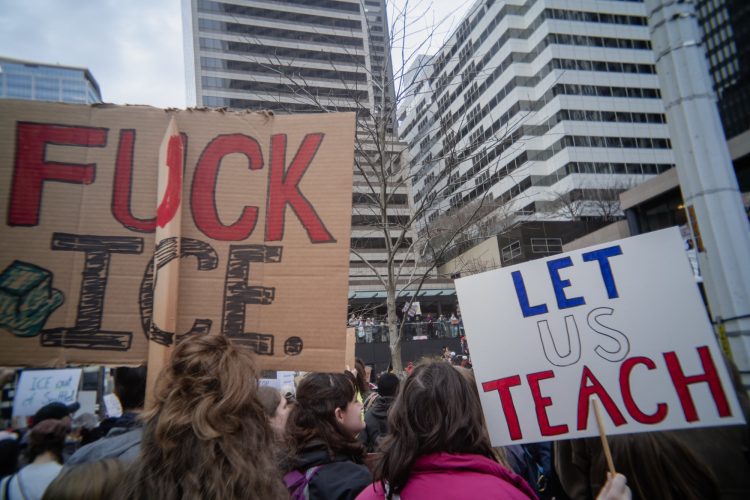
In Congress, Democrats held out for a partial government shutdown rather than approve new funding for ICE without guardrails to rein in agents’ behavior. While ICE salaries are protected during the shutdown thanks to $75 billion approved in Trump’s One Big Beautiful Bill Act last year, other DHS employees have been working without pay for over a month.
Transportation Safety Administration (TSA) personnel are among those who remain unpaid, leading to staff shortages and long security lines at U.S. airports during the busy spring break travel season. Instead of agreeing to common-sense reform of ICE, Republicans continue to refuse funding for TSA staff, as well as those working in disaster response at the Federal Emergency Management Agency (FEMA) and other essential DHS functions.
Adding fuel to the fire, Trump ordered ICE agents to report to airports beginning on Monday. The move backfired spectacularly within hours, as millions of frustrated travelers were treated to the spectacle of elaborately equipped ICE officers meandering about with nothing to do, even as TSA agents continued to labor without pay.
Activists urge colleges and the NCAA to stop using charter companies that profit from deportation flights
Now that Trump himself has underscored the connection between ICE and air travel, the protests against charter airlines have more opportunities to break through the media clutter.
The “De-ICE These Flights” campaign organized by the Service Employees International Union calls on the NCAA to drop contracts with GlobalX and other charter companies that make money from ICE flights, such as Eastern Airlines based in Kansas City and Omni Air International out of Tulsa, Oklahoma.
“American universities have the power to choose ethical partners,” a campaign petition page reads. “Tell university presidents and trustees to commit to not using ICE-contracted charter flights for March Madness or any event.” Service Employees International, which represents more than 2 million U.S. service and care workers, already gathered thousands of signatures from union members last year to pressure charter companies to stop working with ICE.
The organization Arsenal PAC, which develops digital tools and cybersecurity defenses for activists and journalists, launched a similar “Don’t Fly With ICE” petition urging the NCAA to drop its contract with GlobalX.
“A plane carries 157 people to a detention camp in chains. Hours later, a college basketball team boards the same plane, buckles into the same seats, and flies to March Madness,” the petition page reads. “When our universities use airlines that carry out ICE deportation flights, it tells us that the dignity and worth of those communities — our communities — is not a priority.”
More than 24,000 people signed the petition by Friday, triggering nearly a million emails to five NCAA leaders and 35 university athletic directors, The Houston Chronicle reported.
The campaigns also attracted interest among students, and some are putting the pressure on their schools to stop contracting with companies that operate ICE flights. “Some college students are urging the Houston Cougars and other March Madness teams not to fly with charter airline GlobalX,” the Chronicle reported this week.
In response to inquiry about GlobalX contracts, Tim Buckley, NCAA senior vice president of external affairs, told the Chronicle in a statement: “In order to move all teams to tournament sites safely and on time, the NCAA has to work with all available, FAA-approved carriers.”
The University of Colorado also faced criticism. “Immigrant rights advocates on Tuesday renewed their calls for the University of Colorado to end its relationship with Colorado-based Key Lime Air over its operation of detainee transport flights for U.S. Immigration and Customs Enforcement,” The Daily Sentinel reported.

What happens next?
In widely reported news over the weekend, Trump rejected a bipartisan compromise to pay TSA agents, all but guaranteeing that chaos at the nation’s airports will continue into the near future.
The surrounding discourse calls attention to how the administration’s hardline immigration policies impact everyone and puts pressure on the companies profiting from escalated ICE activity. The next nationwide No Kings Day mass protest against federal government overreach under the Trump administration is scheduled for Saturday, March 28, where immigration is set to be a key issue for demonstrators.
Trump’s unforced error on ICE airport deployments is already having an impact as well. Instead of directing blame for the partial government shutdown toward Democrats in Congress, Trump only succeeded in focusing more attention on his own role in the debacle.
On Monday, Senate Minority Leader Chuck Schumer took the floor with a reminder. “Every time a traveler walks to their gate, or stands in line at security, and sees an ICE agent lurking about, they are going to be reminded of Donald Trump’s chaos,” Schumer said. “They’re going to be reminded of Minneapolis. And they’re going to think ‘the chaos is now coming to my city too.’”
Now, if only corporate America would wake up from its stupor and exercise its voice as well. After all, corporations are people, too.
Image credits: Todd Greene/Unsplash, Michael Hanscom/Flickr, Hillel Steinberg/Flickr