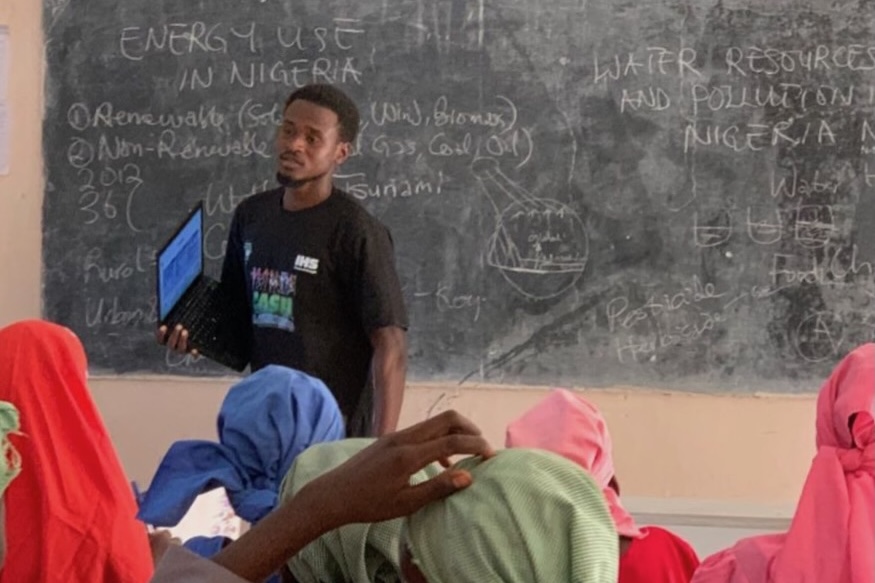

On a January afternoon at Yerwa Government Girls’ School in Maiduguri, the capital of Nigeria’s Borno State, 26-year-old climate educator Aliyu Ibrahim steps into a room of high-school students.
The topic he came to speak about — how climate change and conflict are reshaping Nigerian life — is one Ibrahim knows personally. He grew up in Izge, a village in Borno State near the epicenter of northeast Nigeria’s bloody recent history of armed insurgency. The village was attacked by Boko Haram in 2014, leading to 105 deaths, but the immediate and tragic loss of life isn’t the only way conflict changed Ibrahim’s community. He also saw what the violence did to the environment and the ways local people have lived for generations.
“As a teenager, what stayed with me wasn’t just the sound of firearms, but the silence that followed: abandoned farmlands, dwindling means of livelihoods, drying Lake Chad for fishermen, mounting poverty, and consequently, young people left with shattered hope,” Ibrahim says.
Those experiences inspired Ibrahim and his friends to start the Green Panthers club in 2019. Hoping to reveal the far-reaching impacts of human destruction, the club mobilized volunteers across the region to teach young people about their environment and inform them on how human activities drive climate change and violence damages the resources upon which communities depend.

They teach in English and local languages, mostly Hausa and Kanuri, using visual aids like images and videos of dry farmland, flooded neighborhoods and receding rivers to make the evidence plainly clear. Research has shown that visual aids help strengthen memory retention by anchoring information to concrete, memorable images.
The Green Panthers use free periods in the region’s schools for trainings once a month. When conflict makes it too dangerous for volunteers to travel, they meet by Zoom. “I believe young people are the future,” Ibrahim says. “We need to start with them.”
Reaching young people on the front lines
Students in Borno State sit at the intersection of climate change and conflict. As insurgents carry out their violent campaigns, they damage and pollute natural resources and force farmers from their land — leaving behind hunger and livelihood crises in local communities already feeling the effects of the changing climate.
“The state is one of the major geopolitical zones in northern Nigeria, facing intense [impacts from] global warming like drought and abnormal heat, which is causing death, damaging farmland and displacing people,” says Mayokun Iyaomolere from the Institute of Ecology and Environmental Study at Obafemi Awolowo University.

Historically, Borno State produced more than 420,000 tons of wheat from its fertile farmland each year, enough to cover almost a third of the nation’s annual consumption. Today, more than 70 percent of the state’s roughly 6 million residents still depend on local agriculture, either directly or indirectly, according to a 2025 study led by Nigerian researchers and published in the International Journal of Agricultural Economics.
But the farming and fishing communities in the region are greatly affected by drought, flooding and other impacts tied to climate change, worsened by insurgency that claimed over 38,000 lives between 2011 and 2023 and displaced millions. Production of staple crops like wheat and millet fell by 80 percent in the years following the emergence of Boko Haram in 2009 and has yet to fully recover. Meanwhile, desertification driven by climate change means the Sahara desert is creeping into northeast Nigeria at a rate of nearly a half a mile every year, reshaping farming communities in Borno and Yobe States and making it harder for people to grow enough food and earn a living.

Against this backdrop, educating young people about what is happening in the region, what’s causing it, and what they can do about it is both a means of survival and an act of resistance.
Ibrahim acknowledges the Green Panthers can’t solve the climate crises in the region on their own. But he believes that imparting climate literacy in classrooms is a starting point to radicalize the situation in the future, arming young people with valuable information so they can take action in their communities and hold those in power accountable.
“Hopefully our initiative will produce more young climate advocates,” he says optimistically.

Students put climate literacy into practice in Nigeria’s Borno State
At the Yerwa Girls’ school, Mabel Natal Ahmad learned about climate change and how to take action through upcycling and tree-planting.
The 17-year-old now makes bowls and spoons from papier-mâché using paper scraps, a technique she learned from the lessons. “We were demonstrated how we can upcycle our discarded papers and sweet candy nylons,” Ahmad says. At home, she shared the lessons learned with her parents and siblings, and now her parents use their discarded beverage cans in their flower nursery.

The lessons helped another student, Fatima Muhammed, 15, conquer her fear of public speaking and feel more confident talking to friends and family about climate change and other issues she cares about. “I would like to be a climate advocate like Aliyu after my education,” she says with a smile.
Beyond Borno, the Green Panthers club has engaged over 200 communities in Adamawa and Yobe states. Together, they’ve planted over 4,000 trees and trained more than 500 teenagers as environmental advocates. Co-founder Ibrahim wants to do even more, but funding limitations and ongoing conflict in the region make it difficult.
“I wish I could reach the neighboring Chad, Cameroon and Niger, but insecurity is restricting this intention, and often short-term funding makes it hard to sustain afforestation beyond one-off activities,” he says. “Land ownership and usage disputes also complicate where and how trees can be planted and protected.”
Most of the club’s activities are supported by government agencies like Borno State’s Ministry of Environment along with individual donors, says Bashir Muhammed, a Green Panthers volunteer.
Even if limited, students educating their friends and relatives shows the compounding impact of the club, and Ibrahim plans to keep expanding as fast as he can. “We’re currently developing information education communication materials that can communicate climate vocabulary into local languages,” he says.