



The 2026 redistricting wars took a turn for the worse last week when the six conservative justices on the U.S. Supreme Court ruled to restrict a key provision of the 1965 Voting Rights Act. The decision in Louisiana v. Callais supports Republican efforts to suppress Democratic voters in Louisiana and elsewhere by creating gerrymandered congressional maps. But the fight is not over yet. Voting rights organizations are pushing back in court, concerned citizens have taken to the streets in protest, and the voters will still have the last word on Election Day.

The long history of the gerrymander
States redraw their electoral maps every 10 years when new U.S. Census data becomes available. Called redistricting, the process is meant to account for changes in population, but it also creates the opportunity for those in power to intentionally manipulate the maps to favor one political party over another, known as gerrymandering.
Gerrymanders have been a fixture in U.S. politics for generations. While some states have established non-partisan redistricting commissions, others put state legislators in charge of redrawing the maps — allowing the dominant party to suppress voters in the minority party by dispersing voters in one community among different districts, packing them into selected districts, or both. The practice has intensified in recent years with the aid of modern data collection technology, enabling the dominant party to select its most advantageous voters with laser-like precision.
Ahead of the most recent Census in 2020, the Supreme Court ruled that gerrymandering challenges cannot be heard in federal court. “Since then, Americans have seen gerrymandering ramped up to unprecedented levels in many places — and the worst may be yet to come,” Michael Li, senior counsel with the voting rights organization Brennan Center, warned in 2021.
Last week’s decision made a bad situation even worse by motivating states to draw new maps between the 10-year U.S. Census cycle. The ruling effectively eliminates Section 2 of the Voting Rights Act, which limits racial gerrymandering in states with a history of discriminating against Black voters and other voters of color.

Be careful what you wish for in the redistricting war
Though redistricting between Census cycles is historically uncommon, a number of states have moved to change their maps in an unprecedented standoff ahead of the 2026 midterm elections.
Last year, U.S. President Donald Trump began openly calling for mid-census redistricting in order to guarantee another Republican majority in the House of Representatives for the remainder of his term. The Republican-led Texas state legislature was the first body to respond, proactively adopting a new map in August that they said could give House Republicans as many as five extra seats.
Republican lawmakers in Florida, Missouri, North Carolina, Ohio and Utah soon followed suit, and Democratic-led states hastened to counterbalance with new maps of their own. Voters in California responded with a redistricting measure aimed at growing the Democratic majority by five seats. Virginia voters also approved a new map that would eliminate three of four Republican-leaning districts to establish a 10-1 Democratic advantage, although that move has been challenged in court. Lawmakers in New York and New Jersey have also declared their intention to draw new maps to create new Democratic districts.
After a series of court challenges, in April the Supreme Court ruled that Texas can use its new map for the midterms, but that may not turn out as planned. Some political observers anticipate that the new map’s reliance on the support of Latino voters could backfire, with Republican candidates losing some or all five seats.
A November survey of Hispanic voters in Texas by the organization Unidos U.S., for example, shows that many who voted for Republican candidates in 2024 were already beginning to change their minds just one year later, with an “overwhelming” 81 percent majority expressing concern that Congress is “giving up too much authority” to the president and the executive branch. More recent national polling by Florida International University indicates that the Latino vote has largely swung left, with 60 percent saying they’ll vote Democrat in the midterms.
(Image: Adam Fagen/Flickr)
States rush to redraw maps as the Supreme Court opens the floodgates
That was the state of play up until Wednesday, April 29, when the U.S. Supreme Court added a new element of chaos by invalidating the congressional map in Republican-led Louisiana. The ruling effectively means that states with a history of racial discrimination are no longer required to create majority districts for racial minorities (known as “majority-minority districts”) to temper bias that dilutes voting power among communities of color.
Louisiana Gov. Jeff Landry promptly issued an emergency order halting the state’s primary elections, paving the way to draw a new map that is more favorable to Republicans. The ripple effect has also surfaced in Florida, where Gov. Ron DeSantis successfully lobbied the state legislature to fast-track a new map.
Mississippi lawmakers will also hold a special redistricting session later this month. In Alabama, where Gov. Kay Ivey previously resisted calls to convene a special session, lawmakers met earlier this week to consider eliminating one, or both, of the state’s two majority-Black districts. The change would require annulling the results of the primary election, where voting is scheduled to begin on May 19.

Voting rights advocates fight back, from the statehouse to the street
As anticipated, the president leaped at the new opportunity to pressure more Republican states into redistricting. In a post on his personal social media site on Sunday, Trump exhorted his allies to “demand that State Legislatures do what the Supreme Court said must be done,” in order to gain a solid majority of at least 20 seats in the House of Representatives.
That remains to be seen. The new map in Florida, for example, is already facing a legal challenge, with plaintiffs alleging a clear violation of the Fair District amendment to the state constitution.
Voters and voting rights organizations in Louisiana also filed an emergency lawsuit aimed at stopping Secretary of State Nancy Landry (no relation to Gov. Jeff Landry) from implementing the governor’s executive order. One key matter of contention is another Supreme Court ruling in the form of an unsigned order issued on Monday, which enables Louisiana to redistrict prior to the Nov. 4 general election without waiting for the Supreme Court’s customary one-month rehearing period. Appellants argued the order was issued in error because a rehearing was clearly requested, but the Court rejected the argument earlier today and refused a rehearing.
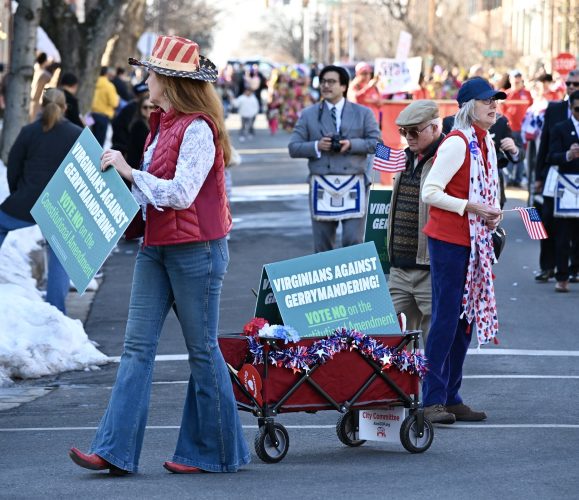
Concerned voters are also taking to the streets in Louisiana and elsewhere. In Tennessee, for example, the state legislature convened a special redistricting session earlier this week, potentially eliminating the only majority-Black district in the state. Republican officials insisted the new map would reflect the “will of Tennessee voter.” Instead, hundreds of people marched on the state Capitol on Tuesday to demonstrate that voters do not approve.
Hundreds of protestors also demonstrated at the State House in Birmingham, Alabama, earlier this week. Democratic office holders have added their voices to the effort, too. In a signal that redistricting has emerged as both a state and national issue in the midterm elections, New Jersey Sen. Cory Booker spoke at a separate press conference in Birmingham alongside former Alabama Sen. Doug Jones, who is running for the governor’s office this year, and Birmingham’s House Representative, Terri Sewell.

The price of eggs vs. the price of gas: Falling approval ratings give way to election chaos
The extraordinary measures undertaken by Trump and his Republican allies to cement a House majority in the midterms has all the appearance of sheer panic, and there is good reason for that. While Republicans successfully leveraged the cost of a dozen eggs to send Trump back into the White House in 2024, grocery prices have only increased over the past year.
Moreover, the price of gas skyrocketed after Trump decided to launch a war against Iran in February, leading to a record-setting disapproval rating of 62 percent for the administration in the latest ABC News poll.
A new NPR/PBS/Marist survey released this week also indicates that Republicans will lose their House majority. “Six months from when votes will be counted this November, Democrats lead by 10 points on the congressional ballot test,” reads the top line of the survey, which asked voters who they would choose if Election Day was today.
Pollster Nate Silver noted a similar +10 result for Democrats from a recent Emerson College poll and observed smaller but significant upward trends in other polls. The Economist/YouGov survey, for example, moved to +5 at the end of April, up from +3 in March.
For all the good news, ABC advised that “Democrats are leading but not running away with the midterm elections at this point.” That is a point well worth taking, particularly so because the six Republican-appointed justices on the Supreme Court have demonstrated their determination to swing the elections in favor of Trump and the Republican party.
Within days of the Supreme Court ruling, Democratic office holders, voters and voting rights organizations mobilized to fight Trump’s latest redistricting push, but they will have to continue engaging voters and grow that movement into an unstoppable force in order to prevail in November.
Image credits: Victoria Pickering/Flickr, Lyndon Baines Johnson Library and Museum (public domain), House Democrats/Flickr, Adam Fagen/Flickr, Paul Becker/Flickr, Victoria Pickering/Flickr


