
The way we produce and distribute food today is deeply broken. Roughly 673 million people across the world deal with hunger every day, while nearly a third of the food produced is wasted in households, the food service industry and retail, according to a 2025 report by the United Nations Food and Agriculture Organization. This waste amounts to almost a quarter of the world’s farmland producing food that will never be eaten, and it is responsible for about 10 percent of all greenhouse gas emissions.
In Brazil, a national network of food banks called Sesc Mesa Brasil is attempting to address these issues with a seemingly obvious solution: reducing waste by distributing edible food that would otherwise end up in a landfill.
Sesc Mesa is the biggest private network of food banks in the country, spanning 100 locations. It receives food donations that do not reach commercialization standards but are still completely safe to eat from private companies like supermarket chains, food brands and festivals. Then, it distributes the food to nonprofits, community projects, and as emergency aid for climate disasters.

In 2024, the network distributed enough donations to feed an average of 2.3 million people every month, Luana Camilo, director of social services at Sesc Mesa, told TriplePundit. The sheer size of its operations is made apparent at its Rio de Janeiro location, a 64,000 square foot building where dozens of workers unload trucks, inspect the food and organize units for distribution.
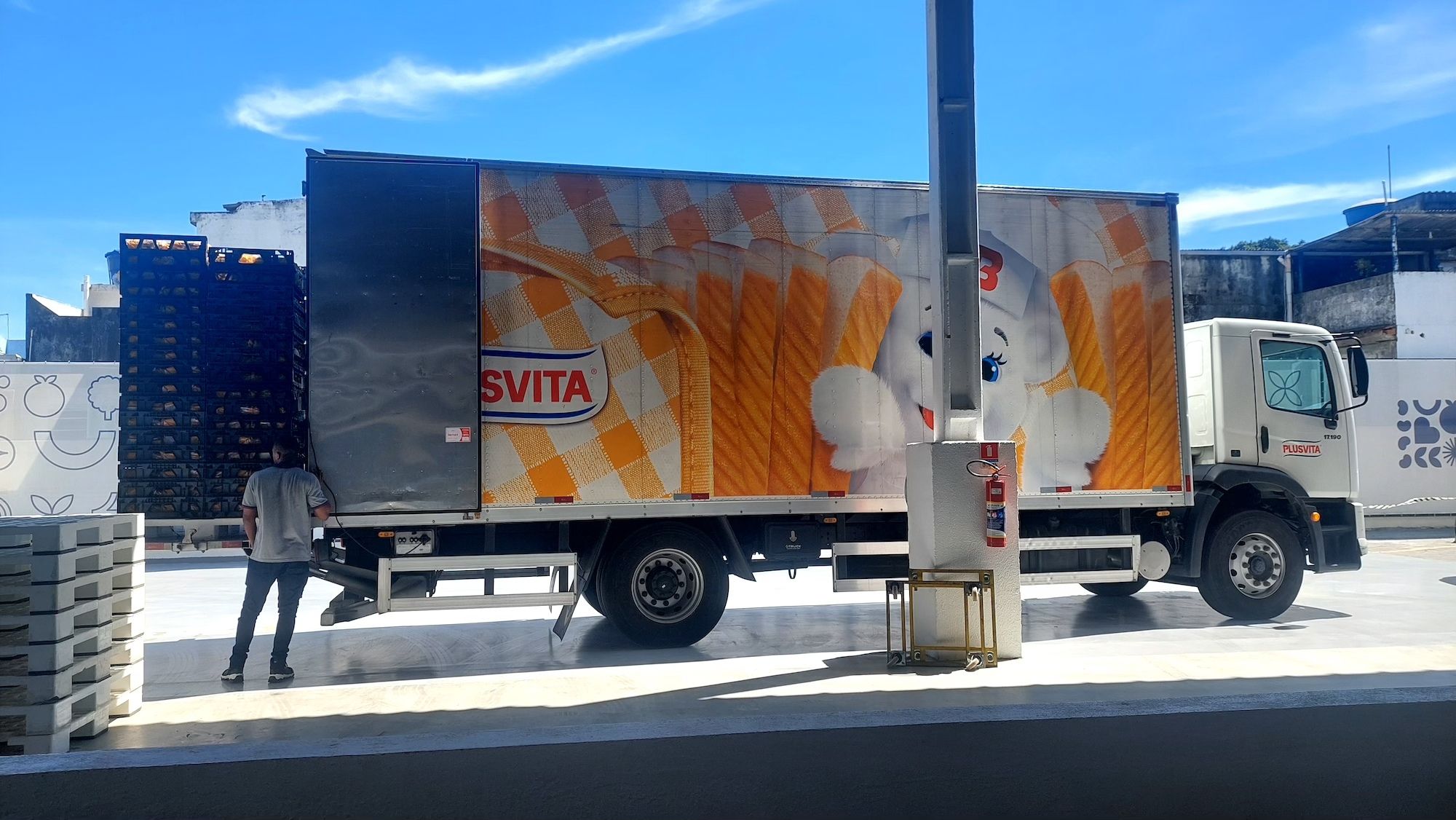
On a sunny day last December, the Rio de Janeiro location received a few truckloads of donations of white bread from a large company. Dozens of men unloaded the trucks and sorted the food. The building already contained tons of food inspected and slotted for distribution. Later, partner nonprofits and community groups would pick up food to distribute to those who need it.
A five-minute drive away, Lar Fabiano de Cristo receives food from Sesc Mesa every two weeks. The institution provides three daily meals, educational support, and shelter for single mothers, the elderly and children in vulnerable communities.
“The impact of our partnership with Sesc is huge, it’s very significant,” said Rosenilda Carvalho, director of the local Lar Fabiano de Cristo location. “We get nutritional enrichment because sometimes all we could give out was boxed juice, but Sesc gives us fruit to make fresh juice.”

In Rio de Janeiro alone, Sesc Mesa has collected over 38,000 tons of food from 800 donor partners since its launch, supplementing more than 174 million meals across all 92 municipalities of Rio de Janeiro state. But there’s a second piece of the puzzle: educating cooks and community members on how to use the produce — particularly the most ripe or niche and specialty produce — to avoid it going to waste upon delivery.
“When the food arrives here, sometimes it is very ripe,” Sesc Mesa’s Camilo said. “The educational actions have this focus for that reason, so that people know how to make use of this food and reduce waste.”
Cooks who work in Sesc Mesa partner nonprofits are trained to ensure that the rescued food is used to its full potential. “Participating in educational programs is mandatory for institutions that want to receive food from Sesc Mesa,” Camilo said. “We teach people how to cut things, whether it needs to be boiled, or how it needs to be cooked for consumption.”
These sessions are also available to the wider public twice a week for free. A large education hall with a show kitchen in the Rio de Janeiro location is used periodically to help individuals reduce waste in their homes and communities.

The misconception that fresh, healthy produce always looks perfect and limited education about the different ways food can be prepared to reduce waste is an obstacle that exists across the world, said Ana Catalina Suárez Peña, senior director of strategy and innovation at the Global FoodBanking Network, a Sesc Mesa partner. Size, color, season and overall aesthetic appeal can affect how a particular kind of food is treated by consumers, and therefore, agricultural producers and retailers.
“In some cases, the consumers are discarding those products,” Peña said. “But that discarding process created a trend that manufacturers, producers and retailers are saying, ‘This food cannot be displayed in our market because people are going to think that we are not selling high-quality food.’”
The solution is education and changing the public’s perception of edible food. To Peña, Sesc Mesa’s work is an example of these necessary shifts in the food system. “We need to prevent the problems to begin with,” Peña said. “We need to move from waste management to waste prevention.”