



The Voting Rights Act of 1965 has been under attack since its inception, and a recent ruling by the U.S. Supreme Court has practically stripped the law of all meaning. Calls for reform have already materialized. In one particularly interesting — and potentially effective — development, a movement spearheaded by the NAACP aims to leverage college sports programs in the South to press for action.
Sports and public protest
Sports are big business throughout the United States, with the National Football League being an especially powerful example of the confluence of culture, money and politics. In 2016, for example, NFL quarterback Colin Kaepernick touched off a media firestorm when he refused to stand for the national anthem before games, citing a series of police brutality incidents involving Black civilians.
“I am not going to stand up to show pride in a flag for a country that oppresses black people and people of color. To me, this is bigger than football,” Kaepernick said in 2016. “There are bodies in the street and people getting paid leave and getting away with murder.”
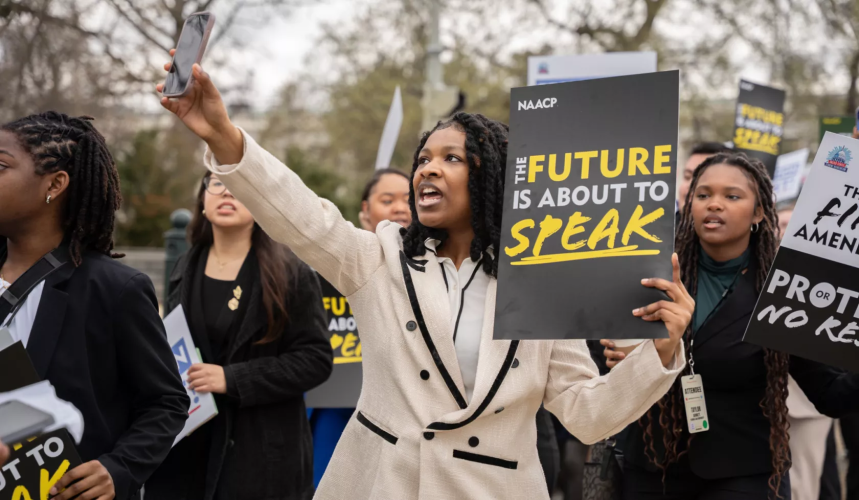
Although Kaepernick lost his career in football after taking a stand, the legacy of his protest is reflected in the new NAACP campaign focusing on college sports. Called “Out of Bounds,” the campaign reminds athletes, fans and the general public that schools in vote-restricting states depend on Black athletes to keep their programs competitive — and keep millions of dollars flowing into their coffers.
Fallout from the redistricting wars
The case that sparked the new NAACP campaign is Louisiana v. Callais, a decision handed down on April 29 by the Republican-appointed majority on the U.S. Supreme Court. The decision provided a legal framework for Republican lawmakers in Louisiana to draw new Congressional maps that suppress Black representation.
Louisiana v. Callais followed a successful gerrymandering effort in Texas and amounted to a seal of approval on racially motivated redistricting from the highest court in the land, inspiring a rush of copycat efforts in other states. “These actions happened in days, in some cases in hours, of a Supreme Court ruling that gives extremist lawmakers a playbook to erode Black representation,” a recent press statement from the NAACP reads.
The Out of Bounds campaign focuses attention on repressive redistricting plans in Tennessee, Louisiana, Alabama, Florida, Mississippi, South Carolina, Texas and Georgia, representing eight of the member states of the lucrative Southeastern Conference in collegiate sports. Overall, the Conference marked a record-setting $1.1 billion in revenue last year. The NAACP estimates that sports programs in the eight targeted states alone generated more than $100 million in annual revenue.
Even as these states depend on attracting Black recruits to keep up with the competition, the voting rights of those same athletes are under attack, along with the rights of their families, friends and communities, the organization emphasized.
“What these states have done is not a policy disagreement. It is a sprint to erase Black political power,” NAACP President and CEO Derrick Johnson said in a statement.
The organization urges the incoming cohort of Black student-athletes to consider committing to one of the nation’s historically Black colleges and universities (HBCUs) instead of entering a public college in the eight targeted states. The organization also asks currently enrolled athletes to leverage their status to help press for change, or consider transferring to another school outside of the targeted eight.
“The state that is working to erase your grandmother’s congressional district is the same state whose governor will stand on the field and celebrate your touchdown or game-winning shot,” said Tylik McMillan, youth and college division national director for the NAACP.
The power of Black athletes
If that seems like a rather ambitious ask, perhaps it is. With Colin Kaepernick’s experience in mind, a direct appeal to Black athletes is unlikely to gain widespread traction among students who have spent a lifetime working toward a career in college-level sports and beyond.
Writing for The Guardian last week, journalist and author Howard Bryant is among those noticing that Black athletes remained largely silent following the series of protests over the murder of George Floyd in 2020.
In another development that evokes pessimism, Black voters moved toward U.S. President Donald Trump, not away, when he swept into office for a second term. A fresh round of support from other minorities and young voters also played a role in Trump’s successful 2024 campaign.
However, Bryant also says it would be a mistake to count the young generation out.
“The NAACP action is a reminder that Black athletes have power — if they choose to use it. They are, like it or not, inextricably linked to the future of Black America because of the economic profits they generate in areas friendly and hostile, and the cultural cachet they hold,” Bryant wrote.
The power of the purse
Regardless of the choices made by Black athletes themselves, the NAACP also enlists the general public in a third course of action, taking the more familiar form of a consumer boycott.
The Out of Bounds campaign urges fans, alumni, donors and members of the general public to boycott sports programs in the eight targeted schools, including team merchandise and licensed apparel as well as tickets to games, and redirect such purchases and donations to HBCUs.
While consumer boycotts are notoriously fickle, they can be effective when deployed against brands that have already displayed symptoms of reputational decline. That certainly describes the Republican brand, considering the growing wave of anger over racist redistricting plans and the downward spiral of the party’s standard-bearer, Donald Trump, in public opinion polls.
In the primary election in South Carolina, for example, advocates traced a record-breaking turnout for early voting yesterday to the Republican redistricting plan, which would have put the minority-majority district represented by Congressman James Clyburn at risk.
“People were upset that this was taking place. And people tend to vote when they get angry. And people were very angry,” Rep. Clyburn told reporters.
Consumer boycotts can also be an effective means of attracting media attention that can have a powerful impact on public policy. In that regard, it’s instructive to recall the events leading up to the passage of the Voting Rights Act, signed by President Lyndon B. Johnson in August of 1965.
Decades of local activism led up to that moment, but the final straw was an egregiously violent effort to silence the Black vote in Selma, Alabama.
At the time, only 335 Black residents of Selma were registered out of a voting-eligible population of 15,000. When local activists organized a protest march on the state capitol, Montgomery, the 600-strong group was blocked, attacked and viciously pursued by police armed with tear gas, night sticks and whips.
The resulting media coverage is credited with motivating thousands of other citizens to travel to Alabama in support of local activists. The march to Montgomery was finally completed weeks later, with Dr. Martin Luther King, Jr. leading 25,000 citizens under the protection of federal officers and the National Guard, while the combination of media attention and mass public protest began to tip the balance in Congress.
It remains to be seen if the Out of Bounds campaign can help touch off a sequence of national engagement beyond the states currently attempting to suppress Black votes. That depends partly on follow-through by fans and other consumers. An initial wave of media attention followed the Out of Bounds launch last week, but sustaining the movement will be a challenge.
Still, voter suppression is not just a Southern issue. It skews representation in Congress, the White House and ultimately the Supreme Court, impacting all Americans, everywhere.
Featured image: Tom Pottiger/Unsplash


