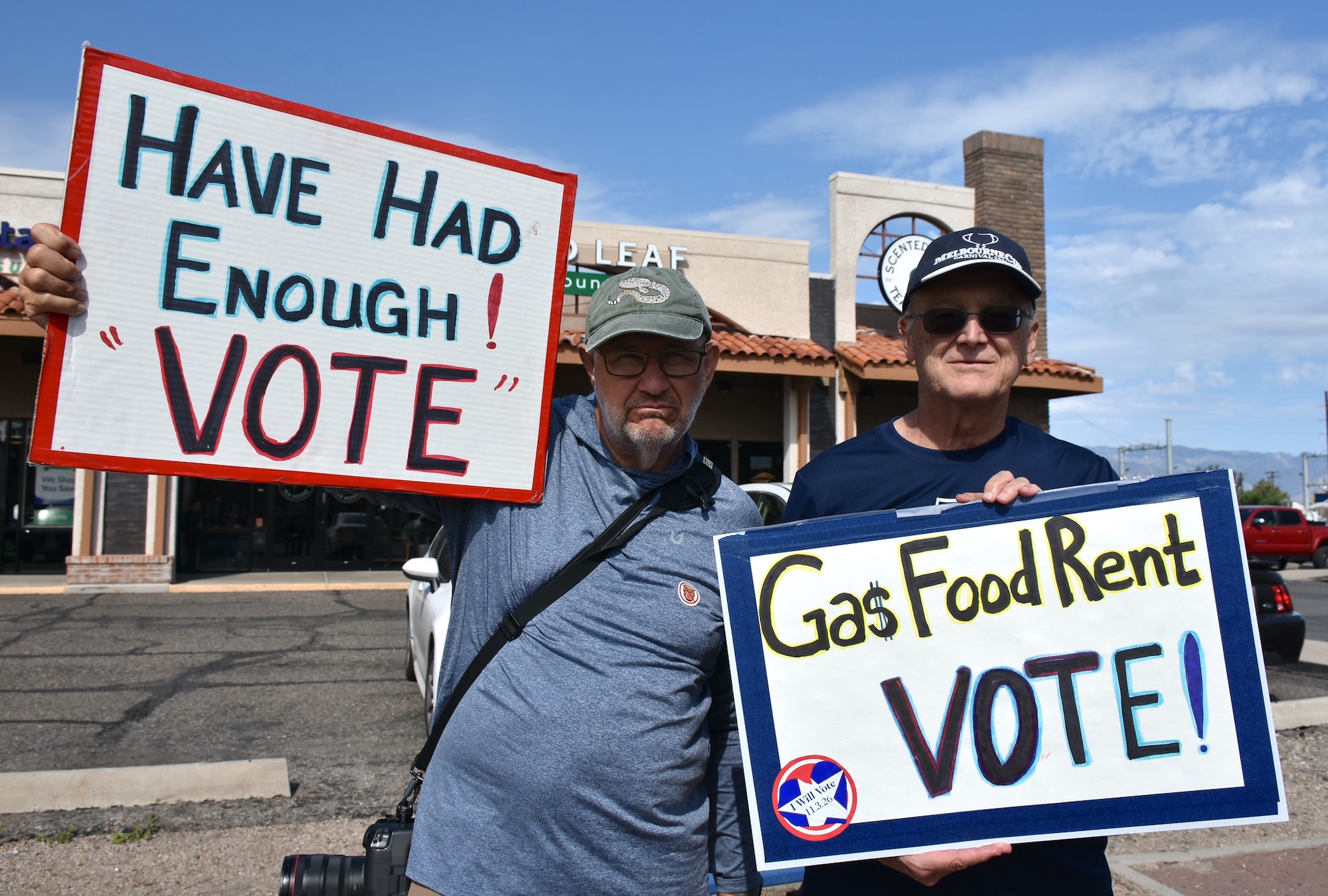

Voters are heading to the polls for the U.S. midterm elections with the economy and the cost of living at the top of their minds. Beyond the headline issues, though, voters across the country are also focused on a range of state, local and hyper-local concerns. Often masked by national aggregates, these granular issues have the potential to swing close elections as people stirred to action locally prepare to make their voices heard.
Cancer in the countryside
Rural communities have been hit hard by new federal trade policies and fuel price spikes impacting the agriculture industry. In some states, residents are also increasingly identifying large farms as a public health issue impacting the water and air quality in their neighborhoods.
In Republican-dominated Iowa, for example, advocates have spent years pushing for action on the state’s alarmingly high cancer rate, which research has linked to agricultural chemicals including pesticides and fertilizers.
The cancer rate has become a high-profile campaign issue in the 2026 race for Iowa governor and other offices, and it’s transcending the traditional partisan animosity. Candidates from both sides of the aisle are seeking the attention of voters concerned about the issue, including members of the MAGA-affiliated, predominantly female “MAHA” public health movement.
The MAHA organization has thrown its support to Republican candidates in Iowa, but Iowa voters in both parties may be primed for a change. In a recent interview, Democratic voter Tracy Jones told the news organization WBUR the state’s cancer rate is her top issue. “The Republicans have had a trifecta in our state for at least 10 years now,” Jones said. “They’ll say that they support cleaning up the water, but they don’t do anything about it.”
Data centers in the backyard
The data center construction boom is another issue poised to shape the vote in communities across the country. Along with fears over the direct environmental, health and quality-of-life impacts of new industrial infrastructure, today’s data centers sit at the nexus of more general concerns about mass surveillance technology, the loss of human jobs, the impact of artificial intelligence on critical thinking and education, and the abusive online behavior enabled by AI chatbots.
Local pushback against data centers has grown quickly this year, transforming once-routine permitting procedures into political hot potatoes. Adding more fuel to the fire, the Donald Trump administration has taken steps to protect data centers against pollution lawsuits.
In addition to state and county-based measures limiting data centers, municipal elections have also become a battleground. In Kansas, for example, citizen petitions have placed data center limitations on the ballot in the cities of El Dorado, Emporia and Ottawa. Residents in 18 Ohio municipalities will also vote on similar ballot measures. In total, voters in 13 states will decide on at least 50 local ballot measures related to data centers this year, including measures that incentivize or restrict them.
Abortion and reproductive rights at risk
Four years after the Supreme Court ruling that overturned Roe v. Wade, a person’s right to choose abortion is now up to each state to decide. Thirteen states have already issued total abortion bans, and the support for reproductive rights will be put to further test in four states this year.
In Idaho, Nevada and Virginia, measures on the ballot affirm a constitutional or statutory right to abortion. If the Idaho measure passes, it will conflict with the state’s existing total ban, with legal challenges all but certain to follow.
The fourth state, Missouri, is a particularly interesting case. A 2022 state law imposed a total abortion ban, which voters promptly challenged with a successful 2024 ballot measure affirming the right to abortion. This year, opponents have placed an anti-abortion measure on the ballot in an attempt to undo the results of the 2024 vote.
About 60 percent of U.S. adults believe abortion should be legal in all or most cases, compared to 38 percent who say it should be illegal. Younger voters are among the most focused on the issue. In recent polling, 77 percent of Gen Z said they worried that they or a loved one could be personally impacted by limits on abortion and other forms of reproductive care, and 69 percent of Gen Z women agree that abortion should be mostly or always legal.
Voting for the right to vote
Systematic voter suppression has been a feature, not a bug, in American democracy since the nation’s founding. Shutting off access to local polling places is one of the strategies that persists to this day. The practice divides local communities, with some residents enjoying convenient access while others go without.
This year, access to on-campus voting is in the media spotlight. College students across the country have organized with former First Lady Michelle Obama’s “When We All Vote” initiative to encourage voting on their campuses where a polling place is available — and to protest where there is none.
In one example that made national headlines, last week hundreds of students in North Carolina marched off-campus to cast their ballots on the first day of early voting, an event organized by students at the historically Black research institution North Carolina Agricultural and Technical State University.
Students from the University of North Carolina at Greensboro and Bennett College also joined for a second march. “When We All Vote helps emphasize the power of our voices, people who are going to lead the country one day,” one student organizer, Jimmy Holt, told local news organization WXii12.
When equality is on the ballot
The Republican-led backlash against diversity, equity and inclusion) (DEI) policies achieved notable legislative success in the years following the 2020 election, with a particular focus on attacking transgender rights.
This “culture wars” strategy reached full bloom this year, but so far many of those anti-DEI messages have fallen flat. In Texas, for example, Democratic U.S. Senate candidate James Talarico is polling ahead of Republican Bill Paxton, despite an onslaught of attack ads and misinformation aimed at ginning up voters against the LGBTQ+ community.
Some states will vote directly on equity issues, including four states considering restrictions on transgender youth in sports and a constitutional amendment in Arizona that could ban DEI programming within city governments and publicly funded education. The League of Women Voters of Arizona is among the many civic organizations lobbying against the amendment, Proposition 142.
“Arizona law already prohibits discrimination and preferential treatment,” the organization argues, adding that the amendment “goes far beyond those protections by restricting public schools, colleges, universities, and local governments from educational programs, training, outreach activities, and discussions related to race, ethnicity, diversity, inclusion, and equal opportunity.”
Americans want to hear more about climate change
Seven out of 10 likely midterm voters across eight battleground states say they would be more likely to vote for a candidate who prioritizes transitioning away from fossil fuels, according to September polling.
While many candidates prefer to articulate the energy transition in terms of pocketbook issues that most voters care about, without wasting time and energy disputing whether or not a climate “hoax” actually exists, voters don’t always agree. More than half (59 percent) of the poll’s respondents said they “want politicians to talk more about climate change and pollution.”
Voters in some states also have an opportunity to shape policy on cannabis and gun control, among other issues on the ballot this year.
Regardless of all the polling and speculation, Election Day 2026 is shaping up as a history-making event for American governance. Once all the ballots are counted, the course of policy on national, state, and local issues will be determined for years to come.
Featured image: dl bone/Flickr