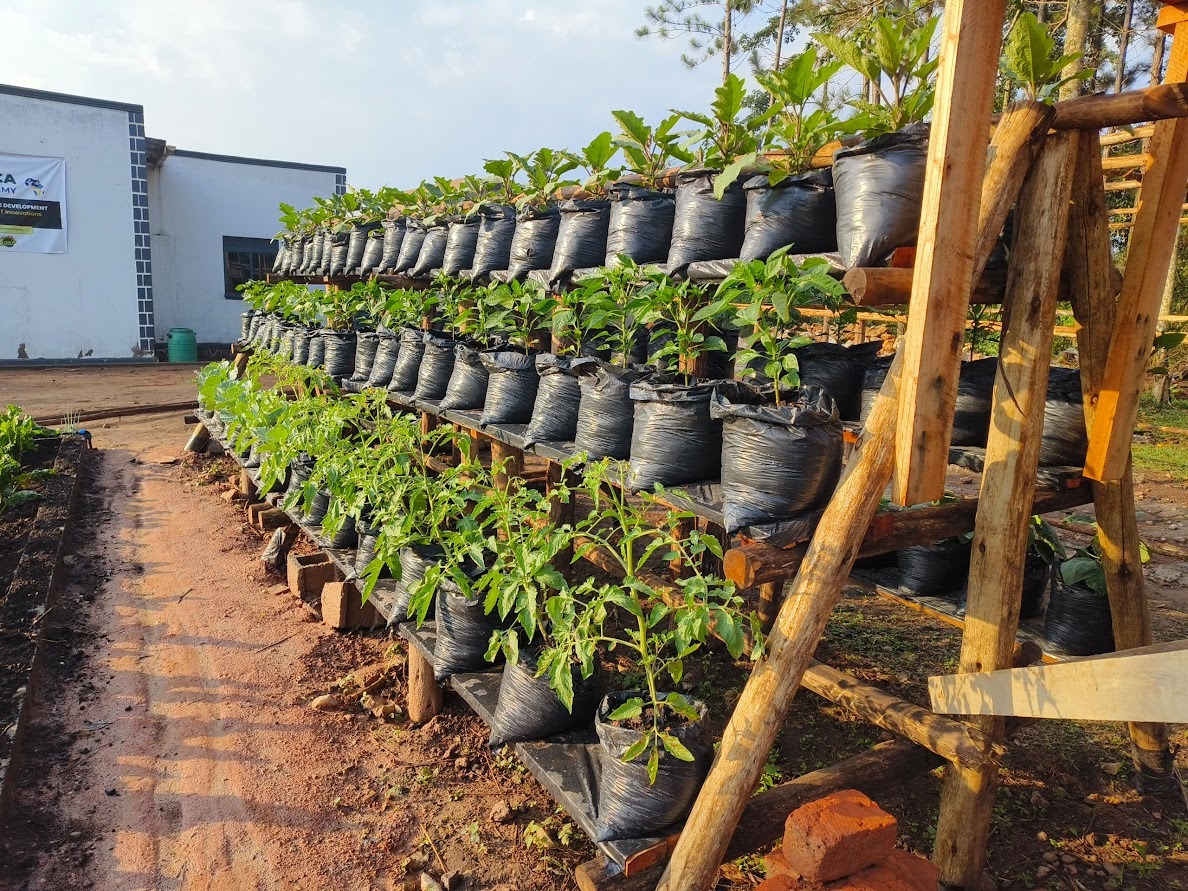

In a dusty schoolyard behind Kanyanya Church of Uganda Primary School in the capital city of Kampala, rows of vibrant green garden sacks are lined up outside the classrooms. The once-forgotten corner of the compound now hosts a vegetable garden that feeds pupils, empowers youth and shows waste can be given a second life.
In a country where 26 percent of children under the age of five suffer from chronic malnutrition, according to the Uganda Ministry of Health, the community farming initiative provides a lifeline and brings much-needed work for single mothers and youth.
The movement started in 2021, when Namaganda Annet, then 24, began planting vegetables in empty rice sacks outside her rented room during the COVID-19 lockdown. “I had no land or capital,” Annet said. “Just a few sacks and the will to survive. Then I thought, ‘What if more youth could join me, and we grew food not just for ourselves, but for schools?’”
Today, her initiative, known as Kanyanya Youth Urban Oasis, has expanded to three urban farming sites in the city. Using rice sacks and recycled bottles filled with soil and stacked on tiered shelves, the avid farmers grow tomatoes, local grains known as amaranth or dodo, and a variety of eggplants known as nakati, among other crops. They harvest nearly 500 kilograms of vegetables each month. With that, they generally contribute to two school lunches per week for hundreds of pupils.
Getting schools on board
In late 2022, the group approached Kanyanya Church of Uganda Primary School with an offer: Give us land, and we will give you food.
“We had our doubts,” said Josephine Nalwoga, the school’s headmistress. “But the students were hungry, it was cheaper [than other alternatives], and the idea was innovative.”
To start, the school gave them a small space to farm, which quickly expanded into a food forest, Nalwoga said.
Now, the school serves vegetables from the farm with its meals twice a week. Hadijah Nakasi, the school cook, sees the difference firsthand.
“Before, we only served posho and boiled beans,” she said. Posho is a mix of maize flour and water, often served as a side dish. “Now, we add greens from the sacks. The pupils enjoy the food more, it’s healthier and they even ask for seconds.”

Kanyanya Youth Urban Oasis has since started a similar arrangement with another school in the city, Mother Care Primary School, where the headmaster Richard Senyondo reported higher pupil energy and improved attendance.
“Seeing their success at Kanyanya, I didn’t think twice when Annet and her team approached me,” Senyondo said, adding that vegetables provide much more than nutrition. “Children who eat well stay focused.”
For the youth involved, the project isn’t just about farming. It’s about giving them work and purpose.
Joweria Nabukeera, age 23, said the experience helped her gain farming and business skills. “I grow food, train others and even help manage school relationships,” she said. “It changed my life.”
Another member and farmer, Edward Luyima, joined the group after seeing its success. “I was amazed at what they were doing with no land,” he said. “I now supply organic compost and help them train other farmers.”
From growing seeds to growing a business
To make the project financially sustainable, the youth group has started collecting agricultural and food waste — like banana peels, maize husks and charcoal dust — and turning it into charcoal briquettes it sells as a more sustainable fuel source.
“We mix the waste with cassava flour and mold it into briquettes,” said Ssekandi Yusuf, a founding member. “They burn longer and produce less smoke than regular charcoal. People are really embracing it.”
The group said it earns 500,000 to 900,000 Ugandan shillings monthly (US$130–$240) from briquette sales to local restaurants and vendors. They reinvest the money into farming tools, seeds, and small side businesses, including poultry and soap-making.
Profits are shared between members, and some money is saved in a pool that members can access for low-interest loans.

The schools and their pupils also benefit. Each partner school forms an eco-club where children learn to plant, compost and understand nutrition.
“It’s experiential learning,” said Joan Nakiryowa, who works for the youth-led local NGO Eco Reset Edge Connect, which provides mentorship to some of the students.
“Pupils don’t just eat. They plant, observe and take these lessons home,” she said. “With this curriculum, many schools are calling us to teach their students.”
Sarah Namwanje, age 10, is part of the eco-club at Kanyanya Church of Uganda Primary School. “I helped plant sukuma wiki [collard greens],” she said proudly. “When I go home, I want to teach my mother how to grow in sacks too.”
Planning for the future
Despite its success, the project faces challenges. Recent heat waves devastated crops, and the group doesn’t have access to irrigation systems or other tools to combat the heat.
“Last season, especially in January and February, we lost a lot of rows of sacks to sunburn,” said Namulindwa Resty, who oversees operations at the Kanyanya site. “Shade nets and water tanks are too expensive for us, so we just pause and wait for the rainy season.”
What’s more, the farming depends on verbal agreements with schools, which could be withdrawn at any time. “We have no written contracts,” Annet said. “We’re grateful, but it leaves us exposed. We hope to formalize these partnerships soon.”
Experts like Moses Bamwine, an urban farming researcher at Makerere University in Kampala, say the model is both timely and replicable. “In a city short on land, sack farming allows people to grow food vertically,” he said. “When linked to school meals, it becomes a powerful tool against hunger.”
The group has dreams of expanding within and beyond the city. “If we can feed a thousand children a week with sacks and waste, imagine what we could do with a small greenhouse, a tank and a little trust,” Annet said.
For now, the next goal is to register formally as a local NGO, secure microgrants and become a recognized force in Uganda’s school feeding strategy. In the meantime, the teams are busy attending to their gardens, providing one school meal at a time.
This piece is published in collaboration with Egab.