
Water scarcity is one of the defining challenges of the 21st century. From drought-stricken regions like California to small island nations, communities are struggling to secure reliable sources of fresh water. Traditional desalination plants that remove salt and minerals from water — large, centralized facilities that rely heavily on electricity, often generated from fossil fuels — have long been part of the solution. But they come with steep financial and environmental costs. Oneka Technologies takes a different approach to desalination: clean, energy-independent, wave-powered buoys.
Founded in 2015, the Canadian-based startup’s name means “water” in the Mohawk language in honor of the First Nation people’s strong environmental values. By harnessing the power of the ocean itself, Oneka’s technology eliminates the need for external electricity, reduces environmental impact, and can be deployed almost anywhere.
Dragan Tutic, Oneka’s co-founder and CEO, said the idea to use wave power came from watching large waves crash against cliffs during a 2012 visit to the island of Corsica with his brother.
“I knew of companies generating electricity from waves by pumping fluids to run generators, and I thought, ‘Why not use that same wave energy to desalinate seawater directly,’” Tutic told TriplePundit. “I knew nothing about desalination, but the inspiration stuck. I realized the ocean provided both an abundant water source and the energy needed to transform it.”
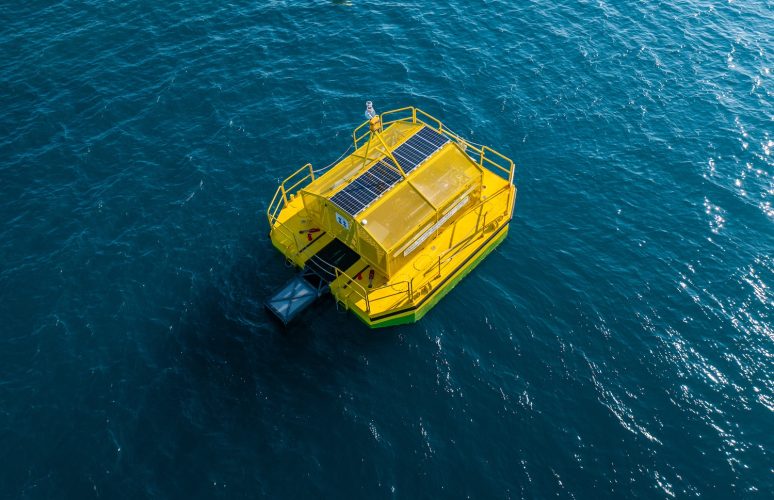
Oneka’s system is fully mechanical. As each buoy rises and falls with the waves, it pumps seawater directly through reverse osmosis membranes that filter out salt and impurities, producing clean drinking water. The clean water is pumped to shore through a single pipeline. It requires no diesel generators, no energy conversion steps, and no dependence on the power grid, Tutic said. This design not only reduces greenhouse gas emissions but also slashes operational costs, making desalination viable in places where grid power is unreliable, expensive or nonexistent.
Building a machine to survive the marine environment was anything but simple. Tutic recalls the early years as a blur of trial and error. “We went through six generations of prototypes. In the early years, everything that could break, did,” he said. “Pumps clogged, hoses snapped, components corroded. I spent countless hours diving, welding and repairing.”
The turning point came in 2020, when Oneka redesigned the buoys so nearly all their components were accessible from the ocean surface. “That innovation improved both serviceability and performance,” Tutic said. “If a community is going to depend on this technology, it has to be easy to maintain.”
Unlike desalination plants, Oneka’s systems are modular. Each buoy produces around 50,000 liters (13,000 gallons) of fresh water per day, or enough for roughly 1,500 people.
“Capacity simply scales by adding more units,” Tutic said. “A 500-room resort might need five buoys offshore. A small city might require a few more. The model is flexible, affordable and quick to deploy.”
That scalability, combined with the ability to start producing water almost immediately, makes the technology especially attractive for coastal towns, islands, resorts, or industries in need of decentralized, resilient water supplies.
Because the buoys operate offshore, durability is crucial. Each unit is anchored like a boat, with moorings designed to withstand storms and heavy seas, making them particularly well-suited for locales with strong wave conditions and growing water stress and climate risks.
“The buoys are designed to ride out waves safely, even during storms, and continue operating once conditions normalize,” Tutic told 3p. “Reliability is essential. When a community depends on your water, you can’t afford downtime.”
Traditional desalination plants face pushback for their environmental footprint. They occupy large parcels of land, discharge salty brine back into the ocean, and sometimes pull in fish eggs or other small organisms through their intake systems. Oneka’s buoys solve for this with industry-standard reverse osmosis membranes certified by the National Sanitation Foundation. The membranes are a fine mesh that’s smaller than fish eggs and operate at low velocity, so marine organisms aren’t sucked in, Tutic said. The brine discharge after that filtering process is about 35 percent saltier than seawater and is released from each buoy into the ocean, where it dilutes rapidly. Depending on local regulations, there may be additional treatment, such as chlorination.
“In California, where environmental standards are some of the strictest in the world, our system achieves compliance within 10 feet of the discharge point 30 times faster than regulations require,” Tutic said. “That’s a huge improvement over traditional desalination.”

Oneka’s first commercial projects are in Chile and California. In Chile, an industrial client turned to the buoys to reduce its use of local fresh water resources. Meanwhile, Fort Bragg, California, is diversifying its supply after drought left its rivers and aquifers unreliable. “Even when Oneka buoys don’t provide 100 percent of a community’s water, they strengthen resilience because the ocean remains a consistent, abundant source,” Tutic said.
Unexpected ecological benefits have even appeared. In Florida, where Oneka tests its systems, the buoy anchors have become artificial reefs. “They’re creating new habitats for marine life,” Tutic says. “It’s a reminder that with thoughtful design, even industrial infrastructure can add ecological value.”
The technology is attracting attention from industrial groups and municipalities in more than 45 countries. “Some industrial clients are heavy water users who want to give back to communities by funding water projects using our buoys,” Tutic said. “With a team of just 40 people, Oneka is focusing on Chile and California first.”
The next step for Oneka is proving the system’s viability and paving the way for broader adoption by delivering water to its first two customers at full capacity. From there, the company plans to reduce costs and expand production.
“The demand for desalination grows every year, driven by climate change, population growth and water stress,” Tutic said. “We want wave-powered desalination to become not a novelty, but a normal part of how communities secure water.”
Editor’s note: An earlier version of this story incorrectly referenced Oneka Technologies’ founding year and the number of moored desalination buoys. We regret the error.